Last month, we heard about Sisera’s dramatic demise at the hands of Jael and her tent peg.
In the chapter’s final verses, we hear Deborah’s song of triumph. She gives us a little glimpse into how she pictures Sisera’s mother, looking out, waiting for the return of her son with the spoils of the attack.
We don’t know her name, but we believe she wasn’t an Canaanite, Sisera’s name indicates that he came from Hittite roots or maybe a seafaring group known as the Sea Peoples who settled along the Levantine coast. This would mean that perhaps he was drafted in to lead King Jabin’s army and has resettled his mother too. however, this whole scene is in Deborah’s imagination, although ancient Rabbis have said it may have been a vision. Deborah pictures Sisera’s mother sitting in a lush palace, with maidservants, enjoying the lifestyle that comes with her son’s position.
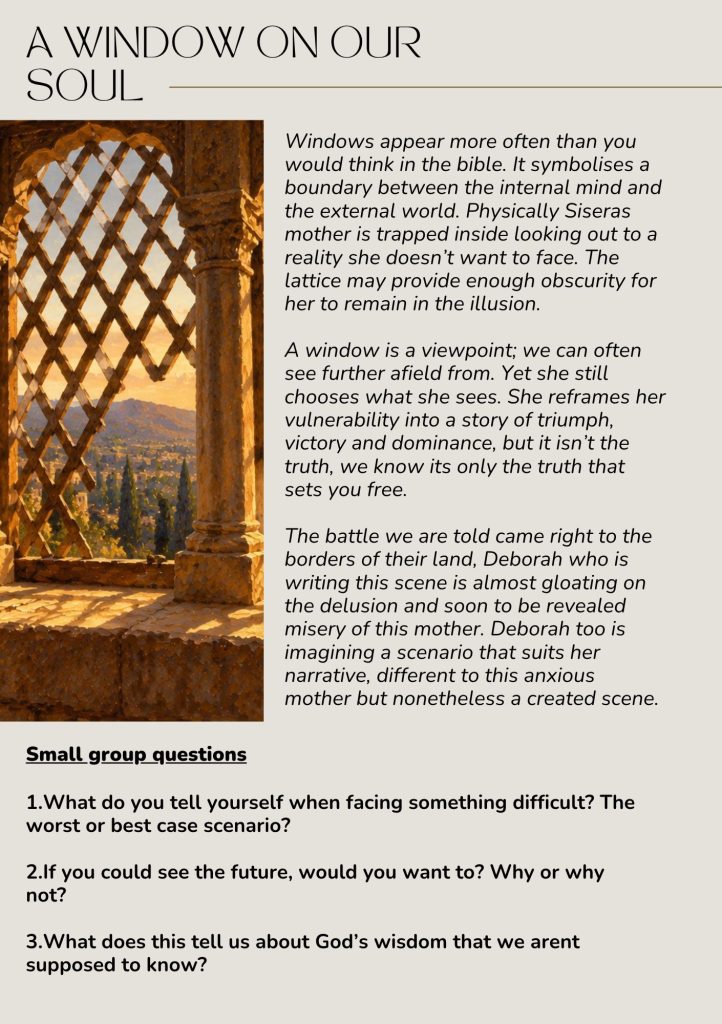
And that’s where we meet her for the first time, in a privileged position, looking out through a latticed window awaiting the return of her boy, laden with embroidered silks and riches. The battle came to the very edges of Hazor (or Harosheth) I wonder if she could have maybe heard the battle from this window, the cries of the men, did she dare let even the thought of defeat and loss enter her mind….even for a minute?
As the minutes turn into hours, she paces, what could be keeping him? Why is he so long in returning? We of course as onlookers already know he will not be coming home. I think, but I can’t prove that somewhere she knows this too.
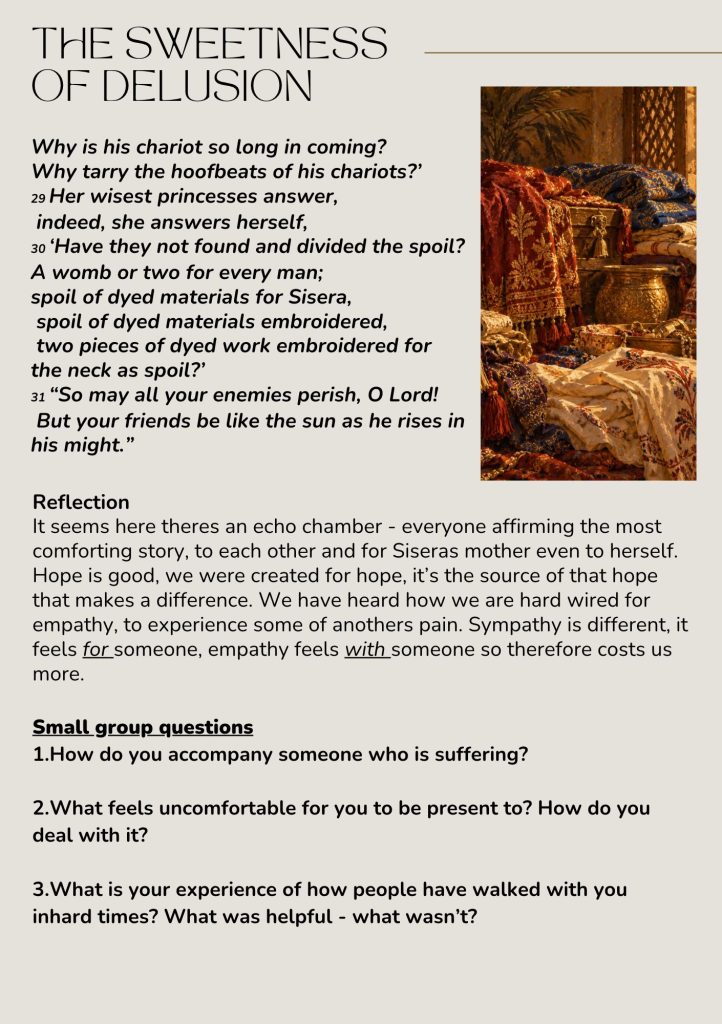
It’s her maidservants that really interest me, they tell her it’s all fine, that it’s because of the many spoils that he is delayed, that there are so many “wombs” perhaps two for each man to bring back. Shocking to hear that, what the destiny of the captured women would have been facing, but Deborah adds this detail I think with an anger at her core, maybe to justify the coldness to a mother who will soon face the death of her son.
No one says, “lets wait and see”, no one says, “Do you think something has gone wrong?” and in that situation I think few of us would, maybe if we had we would have been quickly shushed. No one wants to hear that. No one wants the certainty we drape around vain hope marred by a reality check.
But it has led me to thinking about how we accompany people in suffering, why we skip to “you’ll get over it” or “Give it time, you’ll be fine” as a natural response, rather than sitting with the pain, or sitting in the discomfort with them, or that old favourite “God never gives us more than we can handle”. So very hard to hear that when you feel you are doing anything but handling what’s in front of you.
It seems simple enough to accept we want to make them feel better; but there is in fact more to it than that.
The difference between sympathy and empathy is that we can feel for someone compared to feeling with someone and what we were created to experience in these situations tells us a lot about God.
We are hard wired to feel what others feel, it was only in the late 1990s that it was discovered we have Mirror neurons in our brains. So, when you witness someone in pain or distress your brain doesn’t just passively register the event it actively fires up brain cells that fire both when you perform an action and when you watch someone else perform that same action. So when you see someone slice their finger or cry, your mirror neurons fire in a way that mimics their experience. Your “empathy matrix” lights up a part that overlaps with our own pain receptors. Here is the clever part – the cognitive part of our brain takes over and helps us to connect and emote but realise its not our experience, enough hopefully for us to be distanced enough to be helpful.
We were created to “suffer with” one another not simply look on.
I wonder if that empathy is too uncomfortable for some of us. I wonder how much we want to dispel sorrow because of the amount we ourselves feel. Perhaps that’s the point, perhaps that is why we were designed this way. Interestingly when we ourselves do help someone suffering we get the reward of a rush of all the good hormones. This only happens if we’ve entered into the suffering in some way first. I find this incredible – that written into our core is the ability to experience and enter into anothers suffering. I wonder if rather than embracing that as an antidote to the suffering in the world, we have taught ourselves to fear it or at best avoid it.
I’ve also wondered how much of this drives the Assisted Suicide bill – our inability to tolerate proximity to suffering, a twisting of the natural order. Twisted because life is so very sacred it is never our role or right to end a life in order to end the suffering. In most cases, if well managed, the suffering is alleviated by medication, its the discomfort of those attending that seems acute. Elizabeth Kubler-Ross, an expert on end of life nursing wrote extensively how to accompany people in these times.* She tells us to be present and to assist the person into a serene and peaceful stage of acceptance. The fear and anxiety lives only in the demands we put on those dying to fight when the outcome is inevitable.
What I do know is, that in the Gospels Jesus walks time and time again into people’s suffering, His mere presence alleviates it. It’s not a huge leap that we are called to do the same – especially as vessels of the Holy Spirit. We are called to bring that presence, not always with words and wisdom, but always in truth.
*Kubler-Ross, E.M. D (1969). On Death and dying. New York: Macmillan.
Download the small group resource here