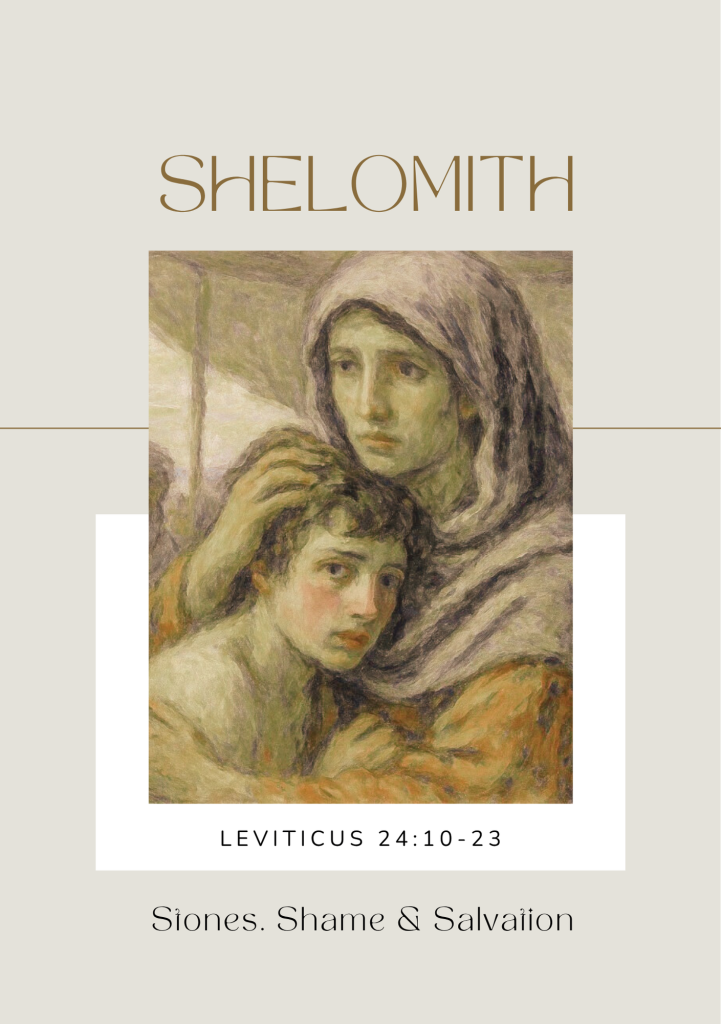
The story of Shelomith touches on a few important issues,
- The Holy name of God, and the seriousness of blasphemy
- The importance of Fathers …and mothers but the influence that fathers have.
- Shame, that destructive emotion that none of escapes in life.
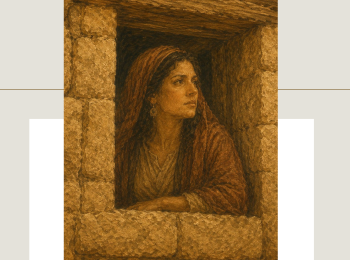
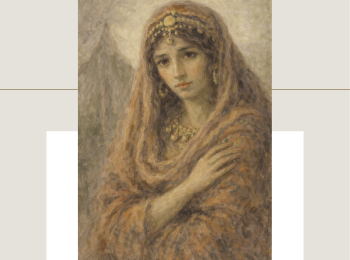
As I’ve spent some time with Shelomith, I wonder how she experienced and dealt with the fallout of a son who in a heated argument blasphemed. Bad enough, maybe in those times, but then her whole community prayed about it and decided his crime was so bad that he should be stoned to death. Apparently, on God’s say-so.
She is the only woman named in Leviticus, yet is labelled only as the woman who’s son was stoned to death for blasphemy. It appears none of the rest of her life’s work meant anything beyond this one incident. It seems something akin to an Aesop’s fable, she serves as a stark warning about how not to raise your Hebrew child.
She is silent in the scriptures, never utters a word, neither condemning him nor defending him. But as a mother myself, I can feel the burden of shame she would have carried. Truly not her shame to carry, but as a mother, you know you would. I think it’s her silence that reveals this to me. The responsibility we seem to carry for our children’s choices lasts well into their adulthood; maybe it never ends.
As is often the way, when I’m mulling over the content of these women each month, God gives me some real-life experience to help me understand.
One woman, recently widowed made a dubious choice and got caught up with a man who wasn’t worthy of her, of anyone really. Her friendship group found out and she was judged quite harshly for the situation. She was vulnerable, and the fallout from this knocked her face down, feeling so ashamed, she started not leaving the house, and some serious self-destructive patterns emerged. Anyone with an ounce of humanity and understanding could see where she was with brokenness and grief when she made those choices. Yet even she couldn’t permit herself a little mercy or forgiveness.
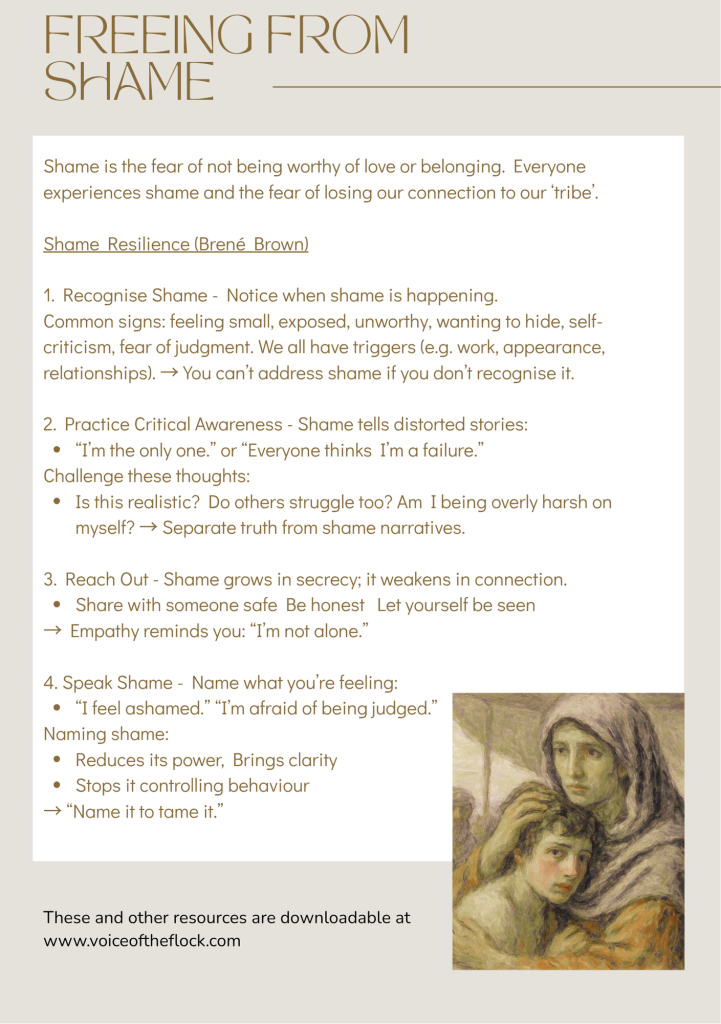
Shame makes us withdraw and silences us. It is the most destructive of emotions. There is no fruit from shame. And it’s only antidote is empathy and forgiveness. There’s a big difference between shame and guilt. Brene Brown – guru of shame and vulnerability explains that Guilt says “I did something bad” but shame, shame says “I am something bad”
It makes us withdraw and hide (aka Adam and Eve)
It makes us feel unworthy
And it isolates us, from each other and from God.
The fear of the disconnection creates secrecy, “If people really knew me they would reject me” and yet Jesus comes right into that, He so beautifully sees people, sees us, knows us, all of us and still chooses to love and connect with us. This is the healing power of our God. This is how He takes away our shame. Like the psalm says there is no place I can hide from you….
So lets look at this situation and try to understand how it got to here. Was the father absent, maybe? Did he stay behind in Egypt ? Was he ever present? Was she a slave used by her Egyptian owner?
Either way, it’s more likely that he wasn’t a follower of Yahweh; his influence may well be the reason the son didn’t have respect for God and His name. Shelomith, it seems, carries this weight by herself. We don’t know what the row was about, I guess it doesn’t much matter, this as one of the newly given commandments was considered of paramount importance.
So what is it about the Blasphemy that makes it a death sentence ?
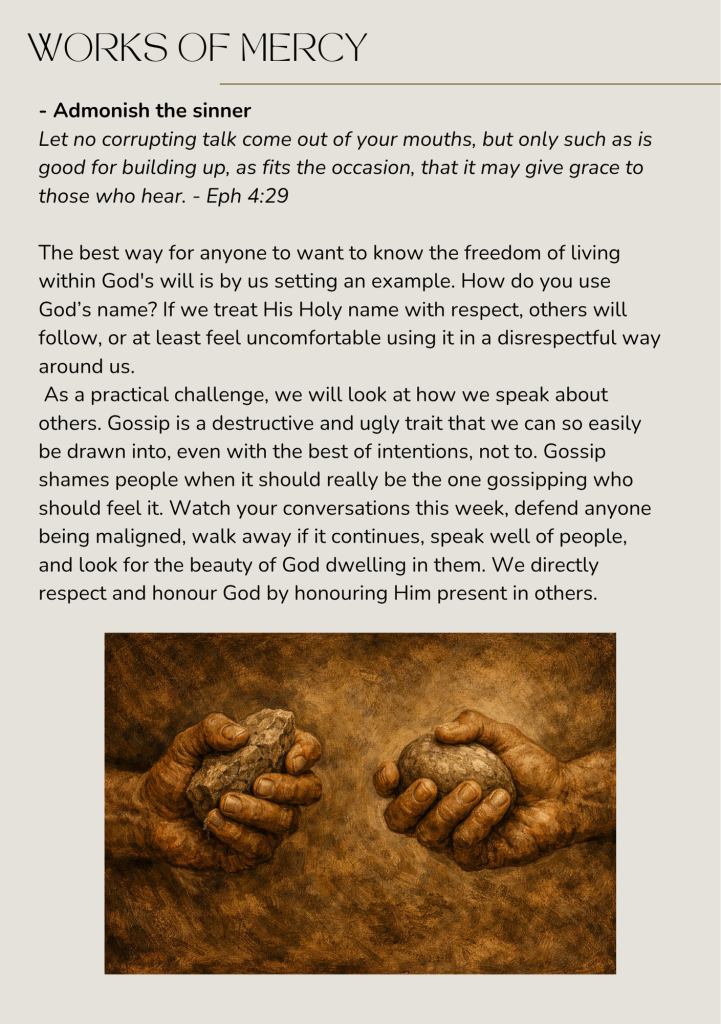
- Firstly it’s a violation of the third commandment – they have only just been given these rules remember, “Thou shalt not take the name of the Lord thy God in vain” was interpreted as a prohibition against cursing or insulting God, seen as an affront to His holiness.
- In the New Testament, Jesus is accused of blasphemy, claiming to be God was blasphemy… unless of course you are actually God.
But for us, now, it’s common for the Name of God to be misused on a 1000 trinkets and t-shirts with OMG printed in sparkly, jaunty fonts. Honestly, it makes me recoil. We are told there is power in the name, we use it to invoke God’s blessing, we call Him, and He is there. Can you imagine the offence Jesus must feel when it is used as a curse or an everyday empty substitute for Wow? Heartbreaking.
This isn’t just a magical phrase, it holds authority, this name can cast out demons, it can heal, it defeats darkness, it invokes the presence of creator of the world… it does deserve to be treated reverently. And so maybe it wasn’t so harsh a punishment. When you are trying to form a people to take its importance out to the rest of the world…I don’t know. Fortunately Jesus has come with all the Mercy of heaven in His hands, so that just like the woman caught in adultery a few hundred years later, we learn that the stones are no longer needed.
You can download the small group booklet here